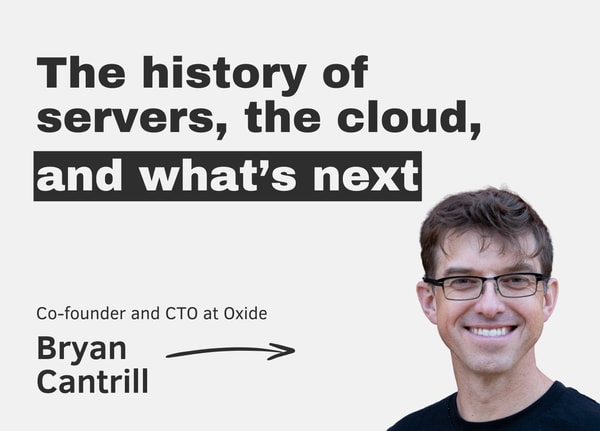
The history of servers, the cloud, and what’s next – with Oxide
The Pragmatic Engineer
20 HOURS AGO
The history of servers, the cloud, and what’s next – with Oxide
The history of servers, the cloud, and what’s next – with Oxide
The Pragmatic Engineer
20 HOURS AGO
Shownote
Shownote
Brought to You By: • Statsig — The unified platform for flags, analytics, experiments, and more. • Linear — The system for modern product development. — How have servers and the cloud evolved in the last 30 years, and what might be next? Brya...
Highlights
Highlights
Bryan Cantrill, a veteran of Sun Microsystems and co-founder of Oxide Computer, offers a deep dive into the evolution of computing infrastructure, drawing from decades of experience at the forefront of systems engineering. From the dot-com era to the rise of cloud platforms and modern AI tools, he reflects on how technological progress is shaped not just by innovation, but by economic cycles, constraints, and cultural choices within engineering organizations.
Chapters
Chapters
Intro
00:00Computer science in the 1990s
01:26Sun and Cisco’s web dominance
03:01The Dotcom Boom
05:41From Boom to Bust
10:26The innovations of the Bust
15:32The open source shift
17:50Oracle moves into Sun’s orbit
22:00AWS dominance (2010–2014)
24:54How Kubernetes and cloud neutrality
28:15Custom infrastructure
30:58Renting the cloud vs. buying hardware
36:10Designing a computer from first principles
45:28Why everyone is paid the same salary at Oxide
50:02Oxide’s software stack
54:14The evolution of software updates
58:33How Oxide uses AI
1:02:55The limitations of LLMs
1:06:05AI use and experimentation at Oxide
1:11:44Oxide’s diverse teams
1:17:45Remote work at Oxide
1:22:44Scaling company values
1:24:11AI’s impact on the future of engineering
1:27:36Bryan’s advice for junior engineers
1:31:04Book recommendations
1:34:01Transcript
Transcript
Gergely Orosz: Can you tell us about the dot-com boom?
Bryan Cantrill: We did much more technically interesting work in the bust than we did in the boom. There's a degree to which innovation requires some level of desperation, that good economic times are...